Features 01
Expected Problems
・Are you experiencing long line stops in process lines such as the CAL, CGL, etc.?
・Are you having trouble accurately detecting weld defects with the existing welding temperature measurement technology?
Features 02
Technology highlight
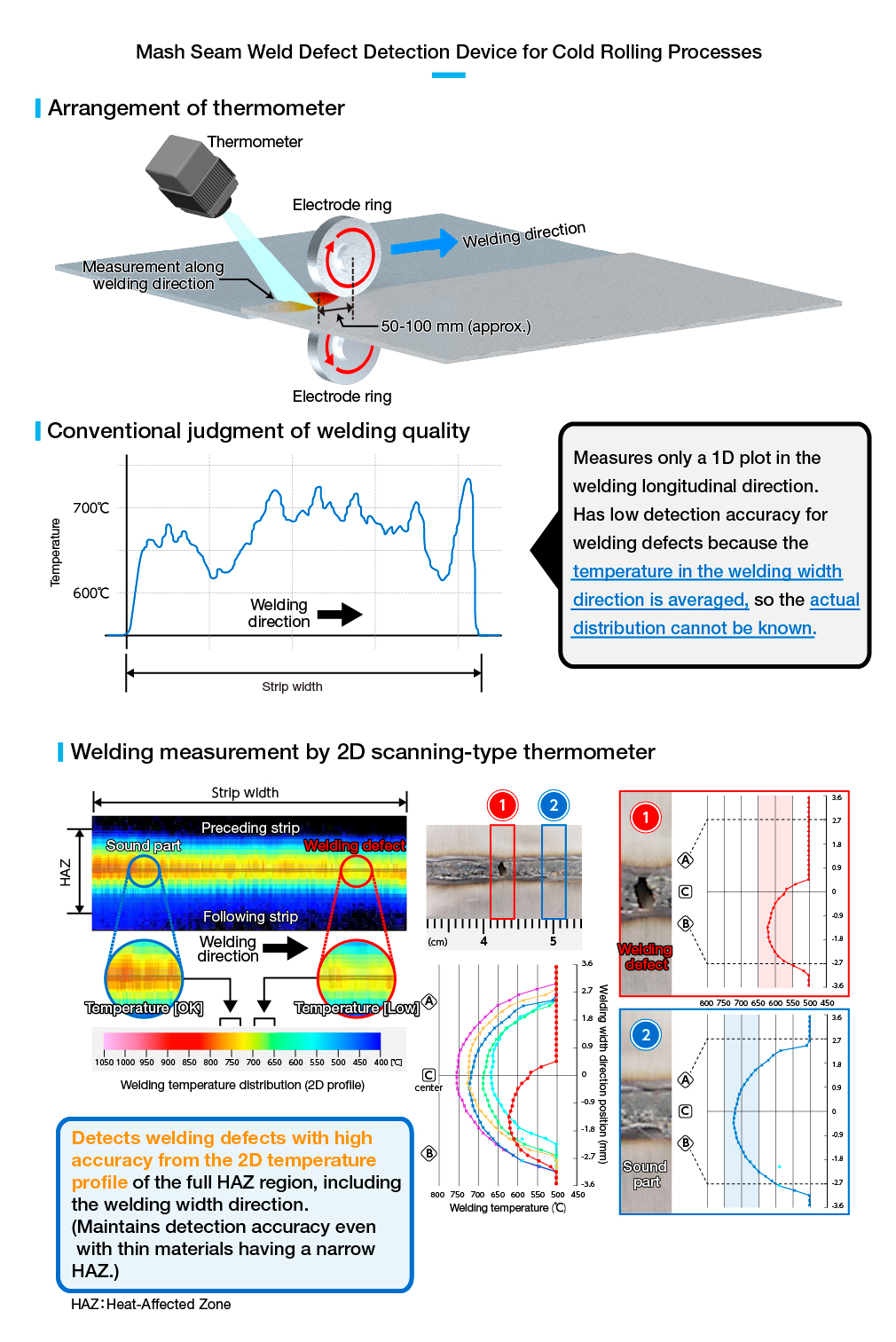
With the conventional measurement method, the soundness of welding is evaluated based on 1-dimensional data in the welding direction obtained with a spot thermometer. Because the measured value is the average value in the measurement region, it is not possible to understand the temperature distribution in the welding width direction, so local weld defects cannot be detected. In particular, in thin materials with a narrow HAZ (heat-affected zone), there is a possibility that
weld defects may be missed.
This technology using a 2D scanning-type thermometer, which can also measure the temperature distribution in the welding width direction, to visualize the temperature of the full length/full width of welds, enabling accurate detection of welding defects, even in thin materials.
Features 03
Proposed Solutions (Examples)
Now applied at cold-rolling process lines of JFE Steel, and has a proven record of reducing welding breakage.
Can be retrofitted to existing process lines with a mash seam welder.
• Particularly effective for thin product lines (Tin-CAL, ETL, TFL)
• Also effective for thick product lines (Sheet-CAL, CGL, etc.).
Links 01
Other Solutions